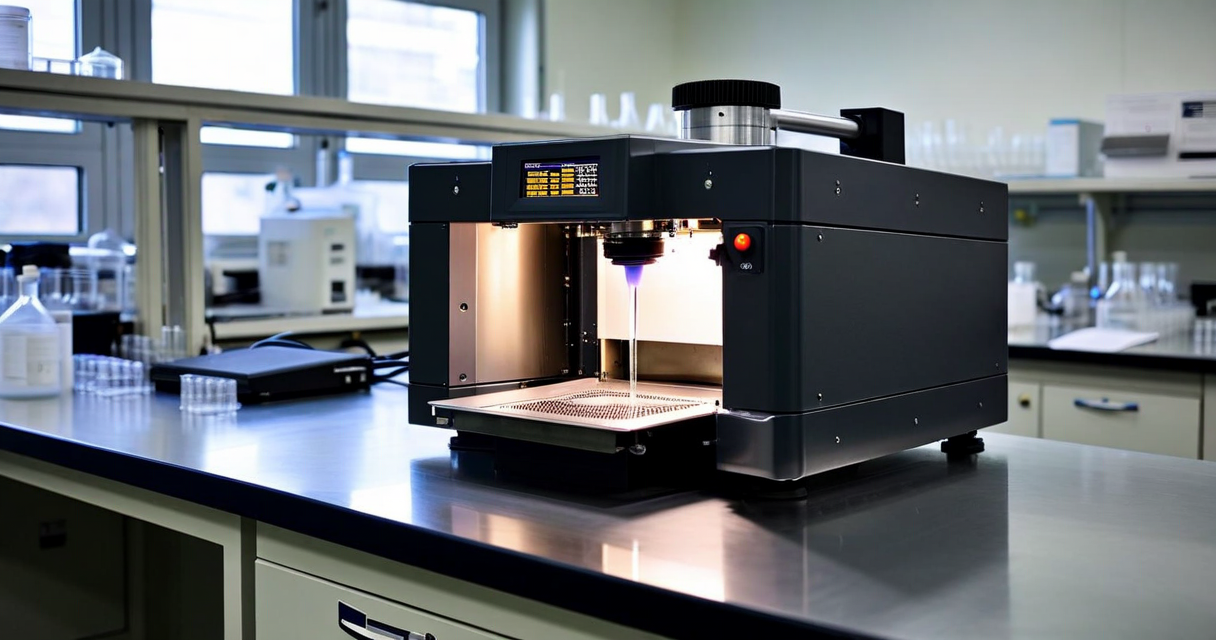
Every batch of NF-400 and NC-200 that ships from our Atlanta facility includes a thermal decomposition onset temperature on the certificate of analysis. That number — typically reported in degrees Celsius — tells our customers the temperature above which our material begins to lose mass in an oxidizing or inert atmosphere. It is the single most important thermal property for any composite destined for use near heat sources, engines, or process equipment operating above 100°C.
Why Decomposition Onset, Not Melting Point
Melting point is the standard thermal reference for homogeneous materials — metals, neat polymers, crystalline compounds. For composite materials, melting point is less useful because the different phases (matrix polymer, reinforcement fiber, any additives) each have different thermal transitions. A PP/nanocellulose composite does not have a single melting point — the PP matrix melts around 165°C, but the cellulose reinforcement does not melt at all. It decomposes.
Decomposition onset temperature tells you when the material starts to change irreversibly. Below that temperature, you can heat and cool the material repeatedly without permanent property loss. Above it, you are burning off some fraction of the material — usually the organic reinforcement phase first. For design engineers specifying a maximum continuous service temperature, decomposition onset is the upper bound they cannot exceed. Our job is to measure it accurately and report it honestly.
The ASTM E2550 Method
ASTM E2550, "Standard Test Method for Thermal Stability by Thermogravimetry," defines how to determine the onset temperature of mass loss in a controlled heating program. The method uses thermogravimetric analysis (TGA) — you place a small sample (5-15 mg) in a precision balance inside a furnace, heat it at a constant rate, and record mass as a function of temperature.
Our TGA instrument is a TA Instruments Q500, calibrated monthly with a nickel Curie point standard (354°C) and verified with calcium oxalate monohydrate decomposition steps. We run a blank (empty pan) before every batch of samples to establish the baseline. Drift exceeding 0.05 mg over the full temperature range triggers recalibration.
We prepare samples by cutting a 5±0.5 mg piece from the molded test bar or mat specimen. For pellet products like NC-200, we use a single pellet trimmed to the target mass. The sample sits in an open alumina crucible — no lid — to allow free gas exchange with the purge atmosphere.
Heating Program and Atmosphere
ASTM E2550 allows the user to select heating rate and atmosphere. We run two programs per batch. The first is 10°C/min in nitrogen (N2) at 60 mL/min flow rate. Nitrogen provides an inert atmosphere that shows pyrolytic decomposition — the material breaking down from heat alone without oxidation. The second is 10°C/min in air (compressed dry air, 60 mL/min), which shows thermo-oxidative decomposition. The air run typically shows earlier onset because oxygen accelerates the degradation chemistry.
Temperature range is 25°C to 800°C for both programs. Most of the interesting behavior occurs between 150°C and 450°C, but we run to 800°C to capture the full residue mass. Residue at 800°C tells you how much inorganic content (ash) remains — useful as a cross-check on reinforcement loading if the reinforcement is mineral-based.
We considered running at 20°C/min to increase throughput, but faster heating rates shift decomposition onset to higher apparent temperatures due to thermal lag. At 10°C/min, our onset values agree within ±3°C with external labs running the same method. At 20°C/min, the discrepancy widens to ±8°C. Since customers compare our data with their own lab results, consistency across labs is more important than throughput.
Determining the Onset Temperature
The onset temperature is not the point where mass loss first becomes detectable — that would be sensitive to noise and baseline drift. Instead, ASTM E2550 defines onset as the intersection of two tangent lines: one drawn along the stable baseline before decomposition, and one drawn along the steepest portion of the decomposition mass loss curve. The intersection of those two lines, projected onto the temperature axis, gives the onset temperature.
Our TA Universal Analysis software calculates this automatically, but our lab technicians verify each onset determination visually. Automated tangent fitting can be thrown off by small pre-decomposition mass loss events — for example, moisture evaporation below 100°C in cellulose-containing composites. We exclude moisture loss from the onset calculation by restricting the baseline tangent to the 120-250°C region where the sample is dry but not yet decomposing.
For NC-200 in polypropylene, the typical decomposition onset in N2 is 295-310°C. In air, it drops to 270-285°C. For NF-400 (PAN-based nanofiber) in polyamide 6, the onset in N2 is 350-370°C and in air is 325-340°C. These ranges represent batch-to-batch variation across our 2024 production. Each certificate of analysis reports the specific values for that batch, not the range.
What the Numbers Mean for Application Engineers
Decomposition onset is an upper limit, not a service rating. Nobody should design a part to operate continuously at 295°C just because the TGA onset in nitrogen is 295°C. The onset measurement uses a 10°C/min ramp — a short exposure measured in minutes. Continuous service involves hours to years of cumulative thermal exposure. Long-term thermal aging studies (ASTM D3045) at specific temperatures provide service life data. We are currently running 1,000-hour aging studies at 120°C, 150°C, and 180°C for both NC-200/PP and NF-400/PA6 and will publish those results when complete.
As a rough guideline based on polymer composite industry practice, continuous service temperature is typically 50-80°C below the TGA decomposition onset. For NC-200/PP with onset at 295°C in N2, that suggests a practical maximum continuous service temperature of approximately 215-245°C — well above the PP matrix softening point, so the matrix limits the design, not the reinforcement.
For NF-400/PA6 with onset at 350°C in N2, the practical continuous temperature range extends to approximately 270-300°C. PA6 itself becomes mechanically weak above 220°C, so again, the matrix is the limiting factor in most engineering designs. The high thermal stability of PAN nanofiber reinforcement becomes relevant in ceramic-matrix or thermoset-matrix composites, which we are exploring but have not yet commercialized.
Quality Control Application
Beyond material characterization, TGA serves as a quality control tool for reinforcement loading. If NC-200 pellets are specified at 22 wt% CNC in PP, the TGA curve should show a mass loss step corresponding to cellulose decomposition (typically 280-360°C) that accounts for approximately 22% of the initial mass. If that step is significantly smaller or larger, it indicates a compounding error — the actual CNC loading deviates from specification.
We run TGA on every fifth production lot as a loading verification check. It takes 90 minutes per sample including temperature ramp, cool-down, and data analysis. The cost is negligible compared to the cost of shipping off-spec material and discovering the error during customer incoming inspection. Two of our automotive qualification customers require TGA-verified loading data on their certificates of analysis. We provide it for all customers regardless of whether they request it.
Requesting Our Thermal Data
Every sample kit shipped from Soarce includes the TGA decomposition onset values for the specific production batch. If you need the full TGA thermogram (mass vs. temperature curve) rather than just the onset number, request it when ordering. We provide the raw data file in TA Instruments format and as a CSV export. The data is yours — we do not restrict redistribution or independent re-analysis. Contact [email protected] for sample kits or specific thermal testing inquiries.