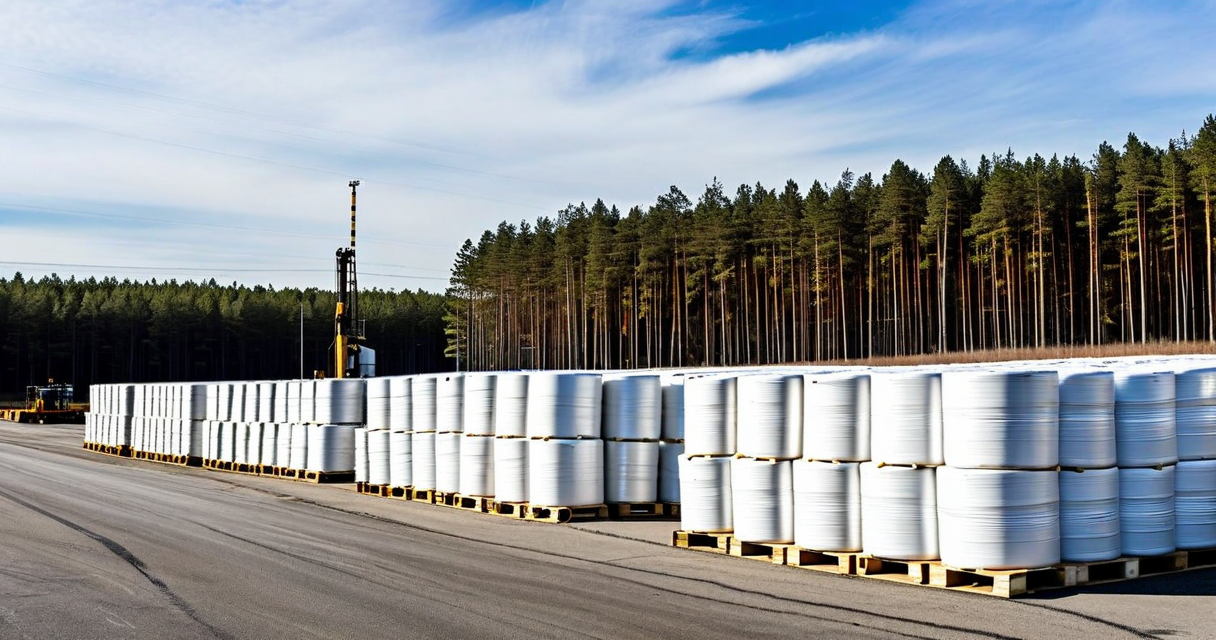
Our NC-200 cellulose nanocrystal product starts as trees. Specifically, it starts as southern yellow pine — Pinus taeda and Pinus elliottii — grown in managed plantations across the Carolinas and Georgia. The path from standing timber to a 5kg bag of CNC pellets involves five distinct processing steps, three different facilities, and a supply chain that we have deliberately kept short, domestic, and auditable.
Step 1: Forest to Mill — Dissolving-Grade Pulp
Our wood pulp comes from two FSC-certified dissolving pulp mills. Both are located within 400 miles of our Atlanta facility. We name the certification standard (FSC Chain of Custody, FSC-C certification numbers on file) but not the specific mills — that is proprietary supply chain information our customers can verify under NDA during qualification audits.
Dissolving-grade pulp differs from paper-grade pulp in cellulose purity. Paper pulp retains 10-15% hemicellulose and residual lignin because those components do not interfere with paper properties. Dissolving pulp undergoes additional alkaline extraction and bleaching steps to raise alpha-cellulose content above 93%. This purity matters for CNC production — hemicelluloses and lignin produce undesirable byproducts during acid hydrolysis and reduce the crystallinity of the final nanocrystals.
We purchase dissolving pulp in sheet form, typically in 300kg bales. The pulp arrives at our facility by truck, roughly one truckload per month at current production rates. Sheet form is easier to store and handle than slurried pulp, and moisture content is controlled at 8-10 wt% — low enough for stable storage but high enough to prevent brittleness during shredding.
Step 2: Pulp Preparation — Shredding and Soaking
The pulp sheets are fed through an industrial shredder that reduces them to roughly 2cm x 2cm flakes. The flakes go into a stirred tank where they are soaked in deionized water for 12 hours to fully re-wet and swell the cellulose fibers. This pre-swelling step improves acid penetration during hydrolysis and produces more uniform nanocrystals.
Water quality matters here. Municipal water contains dissolved minerals — calcium, magnesium, iron — that catalyze side reactions during acid hydrolysis and discolor the final product. We use a reverse osmosis system followed by mixed-bed deionization to produce water below 1 microsiemens/cm conductivity. The RO system generates approximately 200 liters of reject water per 1,000 liters of permeate, which we use for cooling tower makeup rather than sending to drain.
After soaking, we drain the excess water and feed the swollen flakes into the hydrolysis reactor. Typical batch size is 50 kg of dry-weight pulp — that becomes approximately 150 kg of wet flakes after soaking. Each batch produces roughly 20-25 kg of cellulose nanocrystals, depending on hydrolysis yield.
Step 3: Sulfuric Acid Hydrolysis
Acid hydrolysis is the core chemistry that converts bulk cellulose fibers into individual nanocrystals. We use a 64 wt% sulfuric acid solution at 45°C for 45 minutes with continuous stirring. The acid attacks the amorphous (disordered) regions of the cellulose microfibrils while the crystalline (ordered) regions resist dissolution. After 45 minutes, the amorphous regions have been dissolved away, leaving behind rod-shaped crystalline fragments — cellulose nanocrystals — suspended in the acid solution.
The acid-to-pulp ratio is 10:1 by weight. For a 50 kg dry-weight batch, that means 500 kg of 64% sulfuric acid. Working with that volume of concentrated acid requires appropriate engineering controls: a glass-lined reactor vessel rated for acid service, a containment berm sized for full reactor volume, acid-resistant personal protective equipment, continuous acid mist monitoring, and an emergency shower station within 10 seconds of the reactor. Our hydrolysis bay is designed as a separate containment zone with independent ventilation and spill collection.
Temperature control during hydrolysis is critical. Below 40°C, the reaction is too slow and produces low yields. Above 50°C, the acid degrades the crystalline regions along with the amorphous ones, producing shorter crystals with lower aspect ratio and inferior reinforcing properties. Our reactor uses a glycol-water jacket with PID temperature control, maintaining 45°C ± 1°C throughout the reaction.
Step 4: Quenching, Washing, and Concentration
After 45 minutes, we quench the reaction by adding 10 volumes of cold (5°C) deionized water to the reactor. This dilutes the acid below the concentration threshold for continued hydrolysis and drops the temperature below 20°C. The quenched slurry is transferred to a centrifuge for initial acid removal.
Washing is the most water-intensive step. The CNC suspension must be washed until the pH stabilizes above 4.0 and free sulfate ions are below our specification limit. We use a combination of centrifugation and dialysis against deionized water. Dialysis is slower than centrifugation alone but produces a cleaner product — residual acid and dissolved sugars pass through the dialysis membrane while nanocrystals are retained. Total washing time is approximately 72 hours per batch.
The washed CNC suspension comes off dialysis at roughly 2 wt% solids. We concentrate it to 25 wt% using a rotary evaporator under reduced pressure (50 mbar, 40°C). The low temperature prevents thermal degradation of the surface sulfate groups. The 25 wt% paste is our intermediate product — stable for 30 days in refrigerated storage — and is the form that feeds directly into our twin-screw compounding line.
Acid recovery is environmentally and economically important. The dilute acid from centrifugation goes through a multi-stage evaporation system that reconcentrates it from approximately 6 wt% back to 62 wt%. Recovery efficiency is about 85%. The remaining 15% is neutralized with lime and disposed as calcium sulfate (gypsum) — a benign waste product. Without acid recovery, the sulfuric acid cost alone would make CNC production uneconomical at our scale.
Step 5: Quality Control Before Compounding
Every batch of CNC paste is characterized before it enters the compounding line. We measure four properties: particle size distribution by dynamic light scattering (DLS), crystallinity index by X-ray diffraction (XRD), surface charge by zeta potential measurement, and solids content by gravimetric drying. Batches that fail any specification are quarantined and re-processed or discarded.
Typical NC-200 CNC paste specifications: mean particle length 150-250nm (by DLS), crystallinity index above 80% (by XRD peak height method), zeta potential more negative than -30mV (indicating good colloidal stability), and solids content 25.0 ± 1.0 wt%. These specifications were set based on compounding trials that correlated CNC paste properties with final composite mechanical performance. Crystals shorter than 150nm produce lower reinforcement efficiency. Crystallinity below 80% indicates excessive amorphous residue. Zeta potential above -30mV (less negative) indicates insufficient surface charge for stable dispersion.
Why Southeast Sourcing Matters
We could import dissolving pulp from Brazil, Indonesia, or Scandinavia — all major producing regions — at lower per-ton cost. We choose domestic sourcing for three reasons. First, supply chain resilience. Ocean shipping disruptions in 2021-2023 delayed pulp shipments to North American buyers by 4-12 weeks. Our truck-based supply chain has a 3-day lead time and has never experienced a delivery delay exceeding 48 hours.
Second, traceability. Our customers, particularly in automotive, require documented supply chain provenance for sustainability reporting. FSC Chain of Custody certification traces our pulp from a specific forest management unit through the pulp mill to our facility. That documentation is significantly easier to maintain and audit with domestic suppliers than with multi-country import chains.
Third, carbon footprint. Trucking pulp 400 miles from the Carolinas to Atlanta produces approximately 0.02 kg CO2 per kg of pulp delivered. Shipping from Southeast Asia produces 0.15-0.20 kg CO2 per kg. For a product marketed partly on renewable feedstock credentials, minimizing transportation emissions is consistent with the value proposition.
The cost premium for domestic dissolving pulp versus imported is approximately 12-15% on a per-ton basis. For our finished NC-200 pellet product, where raw pulp cost represents roughly 8% of total manufacturing cost, the premium adds about 1% to the pellet price. Our customers have not objected to that differential, and several have told us the domestic sourcing is a positive factor in their supplier evaluation.