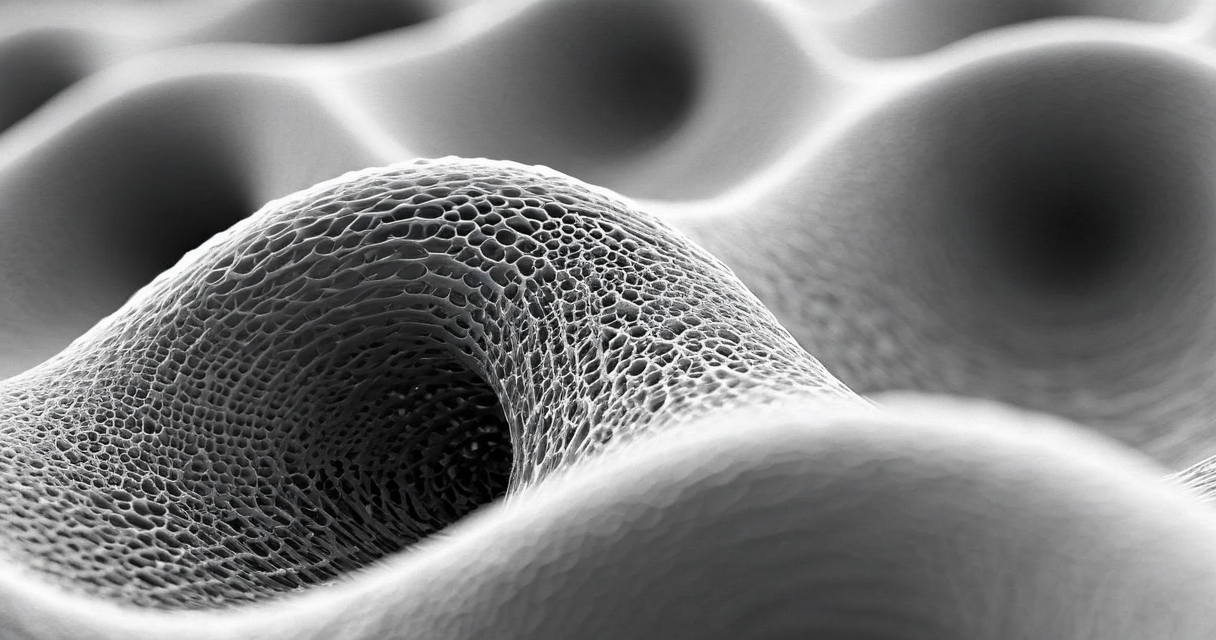
Filtration is the second-largest application area for our NF-400 nanofiber mats after structural composite reinforcement. The principle is straightforward — a mat of sub-micron fibers creates a network of pores whose size is determined by fiber diameter and mat density. Control both, and you control what passes through and what does not. The challenge is controlling both simultaneously at production scale.
Why Nanofiber Membranes Instead of Traditional Filters
Conventional depth filters — meltblown polypropylene, fiberglass pads, cellulose media — have fiber diameters in the 1-20 micron range. Their pore sizes are correspondingly large, typically 5-100 microns. To filter smaller particles, manufacturers stack multiple layers or switch to track-etched membranes, which are expensive and have low throughput.
Nanofiber membranes sit in a useful gap. With fiber diameters of 200-600nm, a single-layer mat creates pores in the 0.2-2.0 micron range — small enough to capture bacteria, fine particulates, and colloidal contaminants, but large enough to maintain reasonable pressure drop. The high surface area per unit volume means dirt-holding capacity is typically 3-5x higher than track-etched membranes of equivalent pore rating. That translates directly to longer filter life and lower replacement costs.
The Relationship Between Fiber Diameter and Pore Size
Pore size in a nanofiber mat is not directly specified — it emerges from the random deposition of fibers on the collector. For a randomly deposited fiber mat, mean pore size scales approximately as: mean pore diameter ≈ 2.5 × fiber diameter × (1/solidity - 1)^0.5, where solidity is the volume fraction of fibers in the mat. This is an empirical relationship derived from modeling randomly overlapping cylinders, and it holds reasonably well for solidity values between 0.05 and 0.30.
For NF-400 standard grade (400nm mean fiber diameter, solidity 0.12 at standard basis weight), the predicted mean pore size is approximately 2.4 microns. Our measured mean pore size by capillary flow porometry (ASTM F316) is 2.1 microns — close enough to the prediction to validate the scaling relationship for engineering estimates.
The practical implication is that to change pore size, you change either fiber diameter or mat solidity (basis weight). Finer fibers produce smaller pores. Higher basis weight increases solidity, which also reduces pore size. Both knobs are available on our production line.
Controlling Fiber Diameter in Production
Fiber diameter in electrospinning depends primarily on polymer solution concentration, applied voltage, and spinning distance (tip-to-collector gap). On our needleless production line, the relationship is: higher concentration produces thicker fibers (more polymer mass per jet); higher voltage produces thinner fibers (more electrostatic stretching); and greater spinning distance produces thinner fibers (more time for stretching before solidification).
For our PAN-based system, the working concentration range is 8-14 wt% in DMF. At 8%, mean fiber diameter is approximately 200nm. At 14%, mean diameter is approximately 600nm. We maintain three standard solution concentrations — 8%, 10%, and 12% — corresponding to our NF-200, NF-400, and NF-600 product designations. The product number is not arbitrary — it is the target mean fiber diameter in nanometers.
Voltage is set at 55-65 kV for all three grades. We keep voltage constant and adjust concentration to hit diameter targets, because voltage also affects fiber collection uniformity. High voltage (>70 kV) causes arc discharge at the collector edges that damages the mat and creates thickness non-uniformity. Low voltage (<50 kV) produces insufficient fiber stretching and creates beaded fibers — segments where the jet collapsed into droplets instead of maintaining fiber form.
Basis Weight and Its Effect on Pore Size Distribution
Basis weight — grams per square meter (GSM) — determines how many fiber layers are stacked in the mat thickness direction. Our standard NF-400 for structural reinforcement ships at 12 GSM. For filtration applications, we produce NF-400 at basis weights from 3 GSM to 30 GSM depending on the required pore size and filtration efficiency.
At 3 GSM, the mat is a sparse single-layer network with large gaps between fibers. Mean pore size is approximately 5 microns. Filtration efficiency for 1-micron particles is around 60%. At 12 GSM, the mat is a dense multi-layer structure with mean pore size of 2.1 microns and 95% efficiency for 1-micron particles. At 30 GSM, mean pore size drops to approximately 0.8 microns with >99.5% efficiency for 1-micron particles, but pressure drop increases 4x relative to the 12 GSM mat.
The tradeoff between filtration efficiency and pressure drop is the core design decision for membrane engineers. Our data sheets provide both numbers for each basis weight option, so customers can select the grade that matches their application requirement without guesswork. We do not recommend a single "best" basis weight because the answer depends on the specific contaminant, flow rate, and acceptable filter replacement frequency for each application.
Measuring Pore Size: Capillary Flow Porometry
We characterize pore size distribution using a Quantachrome Porometer 3G capillary flow porometer per ASTM F316. The method works by wetting the membrane with a low-surface-tension liquid (Galwick, surface tension 15.9 dynes/cm), then applying increasing gas pressure to one side. Smaller pores require higher pressure to overcome the capillary force holding the wetting liquid in place. By measuring gas flow versus pressure, the instrument calculates the pore size distribution.
Three numbers matter from the porometry test: mean flow pore size (the pore size at which 50% of cumulative gas flow has been achieved), largest detected pore (the bubble point — the first pore to open under pressure), and the pore size at which 95% of flow has been achieved. For filtration specification, the largest detected pore is the critical number because it determines the maximum particle size that can pass through the membrane.
For NF-400 at 12 GSM, typical values are: mean flow pore 2.1 microns, bubble point 4.8 microns, 95th percentile pore 3.2 microns. The bubble point is always larger than the mean flow pore because nanofiber mats have a distribution of pore sizes, not a single pore size. If your application absolutely cannot tolerate any particles above a certain size passing through, specify based on the bubble point, not the mean pore size.
Application Example: Industrial Coolant Filtration
One of our current qualification customers is an industrial filtration company evaluating NF-400 mats for metalworking coolant filtration. Their existing filter uses a 5-micron meltblown PP cartridge that captures swarf (metal chips) and tramp oil but misses fine abrasive particles below 3 microns. Those fine particles cause premature wear on grinding spindle bearings.
We provided NF-400 at 20 GSM for their trial. Mean pore size: 1.2 microns. Bubble point: 3.1 microns. In their bench test, the NF-400 membrane captured 99.2% of particles above 1 micron, compared to 78% for their existing meltblown media. Pressure drop at the rated coolant flow rate was 0.15 bar — higher than the 0.08 bar of the existing filter but well within the system pump capacity.
The filter life question is still under evaluation. Their meltblown cartridge lasts approximately 2 weeks in service before the pressure drop exceeds 0.5 bar and triggers replacement. The NF-400 membrane has higher initial dirt-holding capacity per unit area due to its three-dimensional fiber structure, but also has smaller pores that clog faster with fine particles. Preliminary data suggests filter life of 10-14 days — comparable to or slightly less than the existing filter but with dramatically better particle capture below 3 microns.
Custom Pore Size Engineering
If your filtration application requires a specific pore size target, we offer custom production runs with basis weight and fiber diameter optimized for your requirements. Minimum order for custom grades is 100 square meters, which is sufficient for prototype filter elements and bench testing. We provide capillary flow porometry data on every custom production lot.
Contact [email protected] with your target pore size, operating pressure, flow rate, and contaminant description. We will recommend a fiber diameter and basis weight starting point and quote a custom production run within 5 business days.