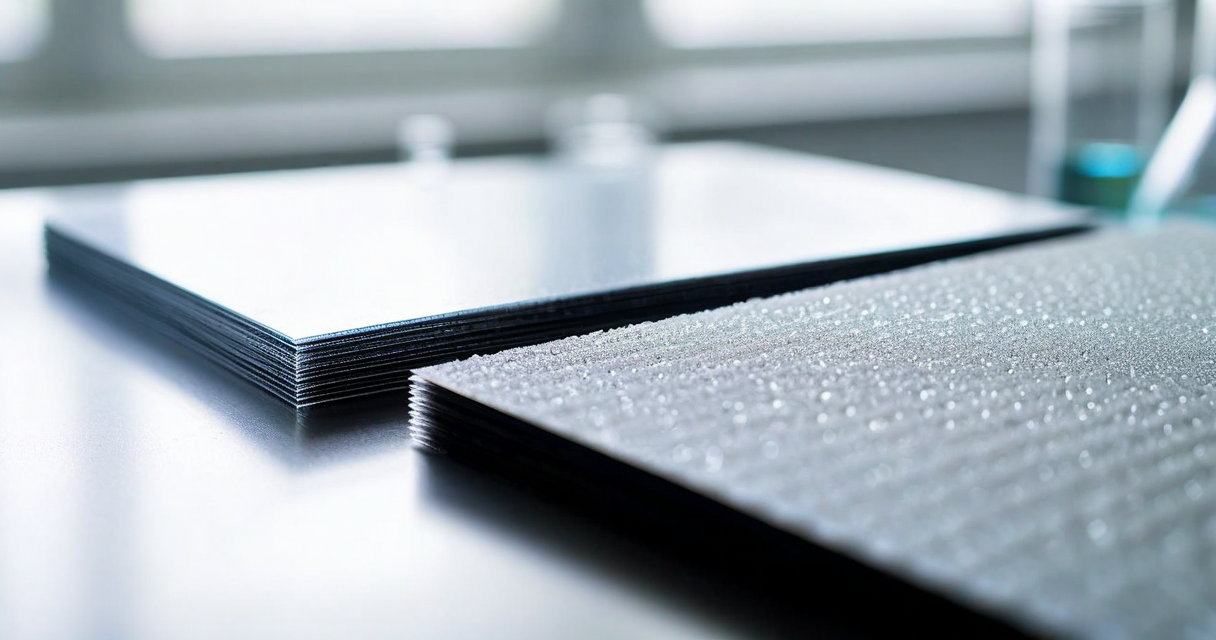
The case for nanocellulose composites often gets made in abstract terms — lower density, renewable feedstock, comparable mechanical properties. We wanted concrete numbers. So we ran a head-to-head test: NC-200 cellulose nanocrystal pellets against standard E-glass short fiber, both compounded into a polypropylene matrix at loadings designed to match flexural modulus. The results are below.
Test Setup and Sample Preparation
We compounded both materials on our 35mm co-rotating twin-screw extruder. For the E-glass reference, we used commercially available 3mm chopped E-glass strand at 30 wt% loading in isotactic polypropylene (MFI 12 g/10 min). For NC-200, we prepared two loading levels — 15 wt% and 22 wt% — because nanocellulose reinforces more efficiently per gram than glass, and we wanted to find the loading that matched the glass fiber flexural modulus as closely as possible.
Both compounds were injection-molded into ASTM D790 standard test bars on a 120-ton hydraulic press. Mold temperature was held at 40°C for all samples. We conditioned test bars at 23°C and 50% relative humidity for 48 hours before testing per ASTM D618.
Testing was performed on an Instron 5566 universal testing machine in our Atlanta lab. Three-point bend fixture with 64mm span. Crosshead speed 2.0 mm/min. We ran 10 specimens per condition and report averages with standard deviation.
The Flexural Modulus Numbers
The 30 wt% E-glass/PP compound produced a mean flexural modulus of 5.42 GPa ± 0.18. The 22 wt% NC-200/PP compound produced 5.31 GPa ± 0.22. The 15 wt% NC-200/PP compound came in at 4.10 GPa — not quite a match. So the relevant comparison is 30 wt% glass fiber against 22 wt% nanocellulose for equal stiffness.
The standard deviation on the NC-200 samples was slightly higher than glass fiber. We attribute this to the challenge of achieving perfectly uniform CNC dispersion at higher loadings. Our Q3 2025 compounding line upgrade addresses this with a longer mixing section and modified screw geometry. Field customers running our pellets on their own equipment should expect somewhat lower modulus variance after that change.
Density and the Weight Reduction Calculation
This is where the numbers get interesting. Density was measured by Archimedes immersion method per ASTM D792. The 30 wt% E-glass/PP compound measured 1.23 g/cm³. The 22 wt% NC-200/PP compound measured 1.09 g/cm³ — a 38% reduction in terms of what that density difference means for a part of equal volume and stiffness.
Put another way: if you injection-mold a 100g door panel substrate from the E-glass compound, you can mold the same part from NC-200 at approximately 88.6g while maintaining the same structural rigidity. That difference adds up across a vehicle. A mid-size sedan has roughly 30–40 polymer composite parts. Substituting NC-200 for glass fiber across the interior trim set could reduce total composite weight by 1.8–2.4 kg, depending on part complexity and existing glass loading.
Flexural Strength: The Trade-Off
Stiffness is one number. Flexural strength — the stress at failure — is another, and here the comparison is less straightforward. The 30 wt% E-glass/PP compound had mean flexural strength of 118 MPa. The 22 wt% NC-200/PP compound had 87 MPa — 26% lower. For applications where the design load is stiffness-governed rather than strength-governed, that gap does not matter. For structural applications with significant point loads, it does.
The practical upshot: NC-200 is a strong candidate for replacing glass fiber in stiffness-governed semi-structural parts (panels, covers, brackets, non-load-bearing housings). It is not a drop-in replacement in strength-governed structural applications without redesigning wall thickness or rib geometry to compensate. We are direct about this with potential customers. Engineers who understand where the tradeoff lives can make good use of our materials. Those who expect identical properties in all respects will be disappointed.
Thermal Behavior Under Load
We also measured heat deflection temperature (HDT) per ASTM D648 at 0.455 MPa. The E-glass/PP compound HDT was 132°C. The NC-200/PP compound was 117°C — approximately 15°C lower. The thermal limitation comes from the nanocellulose phase, which begins to undergo mild dehydration at temperatures above 120°C in sustained loading conditions. For most interior automotive applications this is acceptable. For under-hood or near-exhaust applications, it is not.
Our NF-400 nanofiber mat products, which use polyacrylonitrile or polyamide 6 as the fiber matrix rather than cellulose, exhibit considerably higher thermal stability — onset of decomposition above 300°C. For high-temperature applications, NF-400 is the appropriate product. We will publish separate thermal characterization data for NF-400 grades in a forthcoming article.
What This Means for Sourcing Decisions
The test data supports a clear use-case hierarchy. NC-200 is the right choice when weight reduction is the primary objective, the application is stiffness-governed, operating temperatures stay below 110°C sustained, and the part has complex geometry that benefits from injection molding. E-glass remains the right choice when flexural strength governs the design or when HDT requirements exceed 125°C.
For manufacturers currently running 30 wt% E-glass PP compounds in interior panels, door substrates, trunk liners, or HVAC housings, NC-200 at 22 wt% loading is worth a qualification run. The sample kit includes 5 kg of pellets, the full test report from this study, and our recommended compounding parameters. Contact [email protected] to request one.
Limitations and What We Are Testing Next
This comparison used a single PP matrix. NC-200 behavior in PA6, PA66, and ABS matrices will differ — particularly at elevated temperature. We are planning a polyamide matrix comparison study for Q2 2025 that will include both short-term mechanical testing and 1,000-hour aged specimens. We will publish those results here when they are complete.
We are also preparing impact data per ASTM D256 (Izod notched) for both NC-200 and NF-400 grades. Notched impact resistance is frequently the deciding property in applications with drop or crash loading requirements. Early lab results indicate NC-200 impact resistance is lower than glass fiber but higher than unfilled PP — we will have complete data by April 2025.