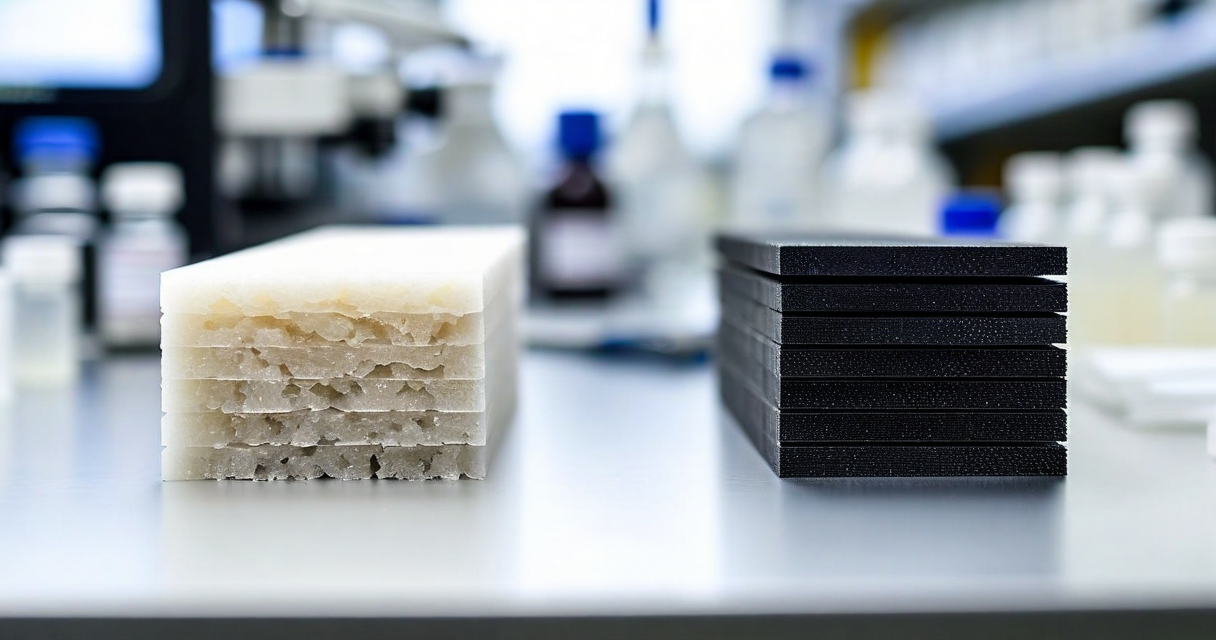
Carbon fiber is the benchmark. When anyone evaluates a new composite reinforcement material, the first question is always "how does it compare to carbon fiber?" The honest answer for nanocellulose is: it doesn't match carbon fiber on absolute performance. It doesn't need to. It matches carbon fiber on cost-normalized performance — and that is the metric that matters for 90% of industrial applications.
Setting Up the Comparison
A fair comparison requires fixing the matrix polymer, the processing method, and the performance metric. We chose injection-molded polyamide 6 (PA6) as the matrix because both nanocellulose and short carbon fiber are commercially available in PA6 compound form. The performance metric is flexural modulus — the stiffness measure most relevant to structural panel applications.
Materials tested: Soarce NC-200 at 22 wt% CNC in PA6 (our standard automotive grade), and a commercially available 20 wt% short carbon fiber PA6 compound from a major European compounder. Both were dried and injection-molded under equivalent conditions (265°C melt, 80°C mold, 3mm test bar per ASTM D790).
We deliberately chose 22 wt% CNC against 20 wt% carbon fiber — not matching weight percentages exactly, but rather comparing commercially realistic loadings for each reinforcement type. Higher carbon fiber loadings are common (30-40 wt%), but so are higher CNC loadings if needed. The goal is to compare what you would actually buy and mold, not a hypothetical matched-loading experiment.
The Raw Performance Numbers
Flexural modulus: NC-200/PA6 at 22 wt% measured 5.9 GPa. The 20 wt% short carbon fiber PA6 measured 14.2 GPa. Carbon fiber wins by a factor of 2.4x on absolute stiffness. No surprise — carbon fiber has a tensile modulus of 230 GPa (standard modulus grade), while cellulose nanocrystals have an estimated modulus of 130 GPa. The gap narrows at the composite level because nanocrystals reinforce more efficiently per unit volume due to their vastly higher surface area, but the gap does not close.
Flexural strength: NC-200/PA6 measured 142 MPa. Carbon fiber PA6 measured 268 MPa. Again, carbon fiber wins, by approximately 1.9x. The strength gap is smaller than the modulus gap because fiber-matrix adhesion plays a larger role in strength than in modulus, and CNC surface chemistry provides good adhesion to the PA6 matrix.
Density: NC-200/PA6 at 1.18 g/cm³. Carbon fiber PA6 at 1.28 g/cm³. The difference is small — 8% — because both reinforcements are relatively low-density compared to glass fiber. On a specific stiffness basis (modulus divided by density), carbon fiber PA6 still leads: 11.1 GPa·cm³/g versus 5.0 GPa·cm³/g for NC-200/PA6.
The Cost Numbers
This is where the comparison inverts. Carbon fiber compound cost varies by supplier and volume, but the commercial compound we tested is priced at approximately $18-22 per kilogram in 500kg quantities. Soarce NC-200/PA6 at 22 wt% is priced at approximately $6-8 per kilogram in equivalent quantities.
The raw carbon fiber that goes into the compound costs $15-25 per kilogram for standard modulus 3K-12K tow, chopped to 3-6mm for compounding. CNC paste feedstock cost is approximately $8-12 per kilogram on a dry-CNC basis, with compounding costs adding $2-3 per kilogram to the final pellet price. The carbon fiber cost is dominated by the fiber itself; the CNC composite cost is more evenly split between raw material and processing.
On a cost-per-GPa basis — the price per kilogram divided by the flexural modulus — NC-200/PA6 comes in at approximately $1.10-1.35 per GPa. Carbon fiber PA6 comes in at $1.27-1.55 per GPa. The two materials are remarkably close on this metric. Nanocellulose has a slight edge at the lower end of the price range; carbon fiber catches up at higher volumes where fiber cost decreases more rapidly than CNC paste cost.
When the Cost Comparison Favors Nanocellulose
The dollar-per-GPa comparison assumes you need maximum stiffness. Many industrial applications do not. A door panel substrate needs 4-6 GPa — well within NC-200 range and far below the 14.2 GPa that carbon fiber provides. Paying $18/kg for 14 GPa when you only need 5 GPa means 64% of the stiffness you bought is unused. In that scenario, NC-200 at $7/kg delivering 5.9 GPa is a 60% cost reduction for the same functional performance.
The cost advantage multiplies for large-volume, moderate-stiffness applications: HVAC housings, consumer electronics enclosures, furniture structural components, sporting goods shells, and automotive interior trim. These applications need stiffness and light weight, but not the extreme performance that justifies carbon fiber's price premium.
Tooling cost is another factor. Carbon fiber compounds, particularly those with fiber lengths above 6mm, are abrasive. They require hardened steel mold inserts and bimetallic injection barrels, adding $5,000-15,000 to tooling costs for a typical part. Cellulose nanocrystals are soft — they do not wear molds or barrels detectably. Standard P20 mold steel and nitrided barrels are adequate for any production volume.
When Carbon Fiber Still Wins
For applications requiring modulus above 10 GPa in an injection-molded part, carbon fiber is the only realistic short-fiber option. CNC cannot reach that level regardless of loading — at very high loadings (>35 wt%), the compound becomes too viscous to injection mold and the brittle-to-ductile transition makes the material unsuitable for parts that experience impact or fatigue loading.
For high-temperature applications above 200°C continuous service, carbon fiber also wins. Carbon fiber itself is stable to 3000°C in inert atmosphere — the limit is always the matrix polymer. CNC begins to degrade at 270-295°C, which constrains the matrix polymer choices and the maximum processing temperature. In thermoset matrices (epoxy, phenolic) cured at moderate temperatures, CNC is viable. In high-temperature thermoplastics like PEEK or PPS processed above 350°C, it is not.
For applications where fatigue life under cyclic loading is critical — structural aircraft components, rotating machinery housings, pressure vessels — carbon fiber composites have a much larger body of fatigue data and validated design methods. CNC composites are too new for long-term fatigue data to be available. We would not recommend NC-200 for a fatigue-critical structural application until we have completed our own fatigue testing program, which is scheduled for 2025-2026.
The Middle Ground Where Nanocellulose Competes
The industrial composite market is not a binary choice between cheap-and-weak (glass fiber) and expensive-and-strong (carbon fiber). There is a large and growing middle segment where manufacturers need better-than-glass performance without carbon-fiber pricing. That is where NC-200 operates. It is not a carbon fiber replacement. It is an alternative for applications that were using carbon fiber because nothing else fit the performance envelope, even though carbon fiber's full capability was not needed.
We encourage prospective customers to test both materials in their specific application and compare total part cost — material cost plus tooling cost plus cycle time cost plus scrap rate. In our experience, the NC-200 total part cost is 35-55% lower than carbon fiber for stiffness-governed parts in the 4-7 GPa range. For a sample kit with both NC-200 and NF-400 materials, contact [email protected].