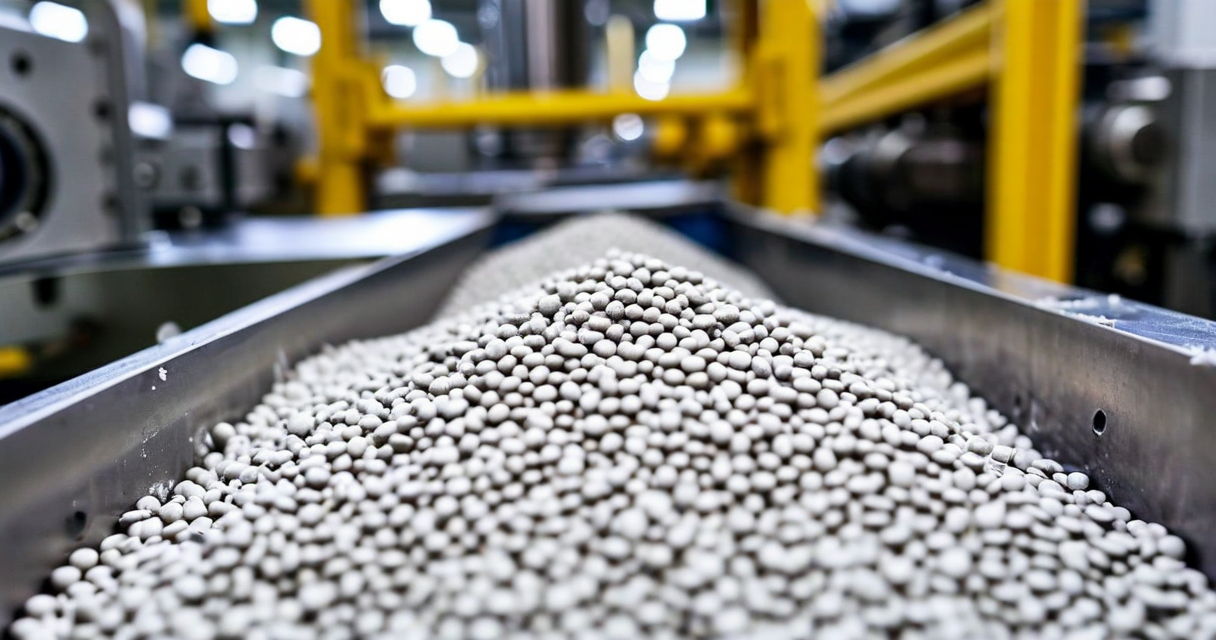
NF-400 nanofiber-reinforced pellets run on standard injection molding equipment. That is the promise we make, and it is mostly true — with adjustments. The purpose of this guide is to document exactly which process parameters need adjustment, by how much, and why. This is not a theoretical discussion. These are the settings we have validated on three different injection press platforms during customer qualification trials.
Material Drying: Non-Negotiable
NF-400 pellets in a polyamide 6 matrix are hygroscopic. PA6 absorbs moisture from ambient air at roughly 0.3 wt% per 24 hours at 50% relative humidity. Nanofiber reinforcement increases the equilibrium moisture content slightly — our NF-400/PA6 pellets absorb about 0.35 wt% per 24 hours under the same conditions.
Moisture above 0.15 wt% causes hydrolytic degradation of PA6 during melt processing. The symptoms are surface splay (silver streaks) on molded parts, reduced mechanical properties, and in severe cases, foaming in the melt stream. We specify a maximum moisture content of 0.10 wt% at the press hopper.
Recommended drying: desiccant dryer at 80°C for 4 hours minimum, 6 hours preferred. Do not use hot air dryers — they recirculate ambient moisture and cannot achieve the required dew point. Desiccant dryers maintain -40°C dew point, which drives PA6 moisture below 0.05 wt% in 4 hours. If your facility does not have a desiccant dryer, vacuum drying at 80°C / -0.9 bar for 3 hours achieves similar results.
We ship NF-400 pellets in vacuum-sealed foil bags with a desiccant sachet. Unopened bags have moisture content below 0.08 wt% at time of shipment. Once opened, the clock starts — bag the unused portion or load it into the dryer immediately. Leaving pellets in an open hopper overnight in a non-climate-controlled plant will push moisture above 0.2 wt% by morning.
Melt Temperature: Narrower Window Than Neat PA6
Neat PA6 injection molding typically uses barrel temperatures of 250-280°C, with significant latitude for adjustment. NF-400/PA6 has a tighter window: 255-270°C. The lower bound is set by the need to fully melt the PA6 matrix — below 255°C, unmelted pellet fragments can appear in the melt stream. The upper bound is set by the nanofiber reinforcement. PAN-based nanofibers in our NF-400 formulation begin to undergo thermally-induced oxidation above 280°C, which degrades fiber-matrix adhesion and reduces tensile strength by 8-12%.
Our recommended barrel temperature profile for a typical 3-zone barrel plus nozzle: Zone 1 (feed): 250°C. Zone 2 (transition): 260°C. Zone 3 (metering): 265°C. Nozzle: 260°C. The nozzle temperature is intentionally set below Zone 3 to prevent drool, which is slightly more pronounced with fiber-reinforced melts than with neat PA6.
Melt temperature measured at the nozzle tip (not barrel setpoint) should be 260-268°C. If your press runs consistently above 270°C at the nozzle despite barrel setpoints within our recommended range, reduce screw speed. Shear heating from excessive screw RPM is the most common cause of melt temperature overshoot in fiber-reinforced materials because the higher melt viscosity converts more mechanical energy to heat.
Injection Pressure and Speed
NF-400/PA6 has approximately 25-35% higher melt viscosity than unfilled PA6 at equivalent temperature. This means higher injection pressure is required to fill the same mold. For a part that fills at 80 MPa with neat PA6, expect to need 100-110 MPa with NF-400/PA6. The exact difference depends on fiber loading, part geometry, and gate size.
Injection speed should be moderate — 30-50 mm/s for most parts. Faster injection speeds (>70 mm/s) can cause fiber orientation effects near the gate, where nanofibers align preferentially in the flow direction. This creates anisotropic mechanical properties — the part is stronger in the flow direction and weaker perpendicular to it. For parts with uniform property requirements, slower fill speeds produce more random fiber orientation and more isotropic properties.
Gate size matters more than with unfilled PA6. Small gates (sub-gates under 1.5mm) create very high shear rates that can cause fiber breakage and flow marks on the part surface. We recommend minimum gate thickness of 2.0mm for NF-400/PA6. Fan gates and tab gates work well. Pin gates below 1.5mm should be avoided.
Holding Pressure and Pack Time
Packing behavior with NF-400/PA6 differs from neat PA6 because the nanofiber reinforcement reduces volumetric shrinkage. Unfilled PA6 has a mold shrinkage of approximately 1.0-1.5% (flow direction). NF-400/PA6 at 15 wt% fiber loading shrinks 0.6-0.9%. At 22 wt% loading, shrinkage drops to 0.4-0.7%. This is a meaningful change for part dimensional control — molds designed for neat PA6 shrinkage will produce oversized parts with NF-400/PA6.
Holding pressure: 60-75% of injection pressure. Hold for 8-12 seconds for a 3mm wall thickness part — adjust proportionally for thicker or thinner walls. Gate freeze-off happens slightly earlier with NF-400/PA6 than with neat PA6 because the higher fiber loading increases the effective melt viscosity near the solidification temperature, causing the gate to seal sooner.
If you observe sink marks on thick sections, increase hold pressure by 5% increments. If you observe flash at the parting line, reduce hold pressure. The window between sink and flash is typically wider with NF-400/PA6 than with unfilled PA6 because the lower shrinkage reduces the tendency for sink marks at a given hold pressure.
Mold Temperature and Cooling
Mold temperature has a significant effect on surface finish and crystallinity development in PA6-based composites. We recommend mold temperature of 80-90°C for NF-400/PA6. This is standard for PA6 applications and does not require mold heating beyond what a typical PA6 mold already has.
Below 60°C mold temperature, PA6 crystallinity decreases, which reduces modulus and chemical resistance. The surface also tends to develop a matte, slightly rough texture due to incomplete replication of the mold surface. Above 100°C, cycle times become excessively long and the risk of sticking to the cavity surface increases.
Cooling time at 80°C mold temperature for a 3mm wall thickness part is approximately 20-25 seconds. Total cycle time (fill + hold + cool + mold open/close) is typically 35-50 seconds depending on machine and part complexity. This is comparable to neat PA6 cycle times for the same part geometry — the nanofiber reinforcement does not significantly change cooling behavior because the thermal conductivity of PAN nanofibers is similar to the PA6 matrix.
Screw and Barrel Considerations
NF-400/PA6 does not cause the barrel and screw wear associated with glass fiber or mineral-filled compounds. PAN nanofibers are organic and soft (Mohs hardness approximately 2, compared to 6.5 for E-glass). Standard nitrided steel screws and barrels have shown no measurable wear after processing 50+ tons of NF-400/PA6 at our customer trial sites. This is a significant cost advantage over glass fiber reinforced PA6, where bimetallic barrels and tool steel screws are recommended and typically need replacement every 2-3 years in high-volume production.
Screw design: a standard 3-zone PA6 screw with 2.5:1 compression ratio works well. High-shear mixing screws (barrier screws, Maddock mixers) are acceptable but not required — the CNC dispersion was already achieved during compounding. Additional distributive mixing in the injection unit provides modest additional benefit to fiber distribution but can increase melt temperature through shear heating.
Screw decompression (suck-back) after plasticization should be 3-5mm. Excessive decompression (>8mm) draws air into the melt, causing splay and voids. With fiber-reinforced materials, the higher melt viscosity makes air entrainment more difficult to purge once it occurs. Keep decompression to the minimum needed to prevent drool.
Troubleshooting Common Issues
Surface splay or silver streaks: check moisture content first. If moisture is below 0.10 wt%, check melt temperature — may be too high, causing fiber degradation. Reduce nozzle temperature by 5°C increments.
Short shots: increase injection pressure by 10% and check for frozen gate. NF-400/PA6 gates freeze slightly earlier than neat PA6. Switch to a larger gate or increase mold temperature to delay gate freeze.
Weld line weakness: fiber-reinforced materials inherently have weaker weld lines because fibers orient parallel to the weld rather than bridging across it. Design parts to place weld lines in non-critical areas. If weld line location is fixed by gate placement, increase melt temperature by 5°C and injection speed by 10% to improve fiber entanglement at the weld.
For specific troubleshooting support or to schedule an on-site process optimization session, contact our applications engineering team at info@soarceusa.org. We offer half-day press-side assistance for customers running NF-400 for the first time.