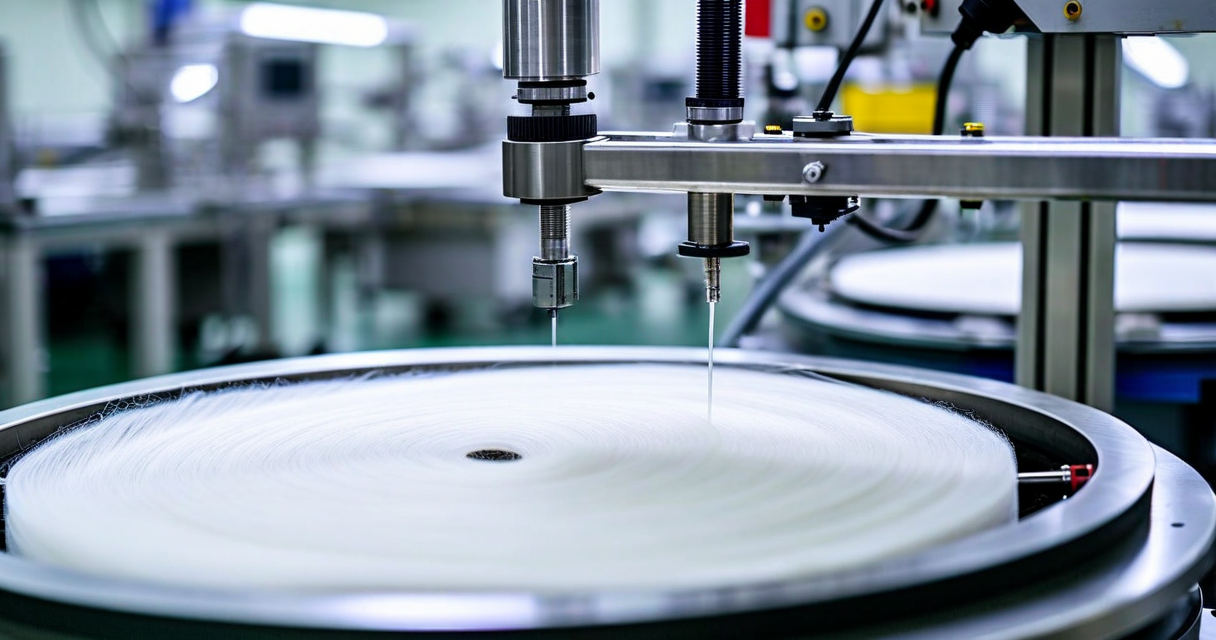
Our first electrospinning setup was a single-needle bench unit that produced 0.3 square meters of nanofiber mat per hour. Our current production line produces 120+ square meters per hour. The distance between those two numbers was filled with process failures that nobody talks about at conferences. Here are five things that broke, why they broke, and what we changed.
Lesson 1: Humidity Control Is Not Optional
Electrospinning in Atlanta, Georgia means spinning in a climate where ambient relative humidity routinely exceeds 70% from April through October. On a bench-scale unit inside an air-conditioned lab, this barely matters — the room HVAC maintains 40-50% RH, and the small spinning zone evaporates solvent efficiently regardless.
On a 1.2-meter production line in a 5,000 square-foot manufacturing bay, it matters enormously. The larger spinning zone creates a solvent vapor cloud above the collector that shifts local humidity by 15-20 percentage points within the first 30 minutes of operation. By hour two, fiber diameter distribution widens from a tight 200±30nm to a scattered 200±120nm. The material is technically nanofiber, but the inconsistency kills mechanical reproducibility downstream.
We solved this by installing a dedicated dehumidification system that maintains the spinning zone at 35% RH regardless of ambient conditions. The system costs $42,000 installed — a fraction of the material waste from running without it. We also added four humidity sensors at different heights within the spinning zone and feed the data into our process control system. If any sensor reads above 42%, the line automatically reduces throughput to maintain fiber quality.
The takeaway for anyone scaling electrospinning: budget for environmental control from day one. Trying to add it later means stopping production for installation, and by that point you have already shipped inconsistent material to customers who expected the specs from your qualification batch.
Lesson 2: Collector Speed Creates Different Problems at Scale
On a bench unit, the collector drum rotates at a fixed speed. At production scale, collector speed directly controls mat basis weight — the mass per unit area that determines downstream mechanical properties. Our NF-400 standard specification calls for 12 g/m² ± 1.0 g/m². Hitting that tolerance consistently requires collector speed control to within 0.5 RPM over an 8-hour run.
The first problem was thermal drift. Our collector drum motor runs through a variable frequency drive (VFD). After three hours of continuous operation, motor temperature increases by 8-12°C, which shifts the motor slip characteristics and changes actual RPM relative to commanded RPM. The VFD reads commanded frequency, not actual shaft speed. We discovered the drift after a customer reported that material from the first quarter of a production roll passed tensile testing, but material from the third quarter did not.
We added an optical encoder to the collector shaft for closed-loop speed feedback. The encoder feeds actual RPM back to the VFD, which adjusts frequency to compensate for thermal drift. Cost: $1,200 for the encoder and integration. The motor drives were already VFD-controlled — we just were not closing the loop. A basic oversight that cost us a customer re-qualification cycle.
The second problem was more subtle. At higher collector speeds, the nanofiber mat builds preferential alignment in the machine direction. Below 200 RPM, fibers deposit randomly and the mat has isotropic in-plane properties. Above 250 RPM, machine-direction alignment becomes measurable. Our standard NF-400 spec assumes isotropic fiber orientation. Production engineers who increased collector speed to boost output inadvertently changed the material properties without changing the product designation.
Lesson 3: Solvent Recovery Changes Your Fire Code Classification
We spin from a dimethylformamide (DMF) / polyacrylonitrile solution. DMF has a flash point of 58°C and a TLV-TWA of 10 ppm. At bench scale, a fume hood handles both the safety and the environmental compliance. At production scale, you are evaporating 8-12 liters of DMF per hour into the production environment. That volume changes your facility classification under NFPA 30 (Flammable and Combustible Liquids Code) and requires a dedicated solvent recovery system to stay within EPA air emission limits.
Our recovery system is a condensation-based unit with activated carbon polishing. Recovery efficiency is approximately 92% — the remaining 8% goes through the carbon beds before exhaust. The entire system was a $180,000 capital expense, plus ongoing carbon replacement at roughly $6,000 per year. We did not budget for this in our original facility plan. When we first signed our lease, we classified the space as light manufacturing. After the fire marshal visited during the electrospinning commissioning, we reclassified to hazardous occupancy H-2, which triggered sprinkler upgrades and additional ventilation requirements.
The recovered DMF is redistilled on-site and recycled into fresh spinning solution. Solvent recycling reduced our DMF purchase costs by approximately 78% — the recovery system paid for itself in 14 months on chemistry savings alone. If we had planned for it from the start, we would have saved three months of production delay during the fire code reclassification process.
Lesson 4: Needle-Free Spinning Needs Different Quality Metrics
Our production line uses a wire-electrode needleless electrospinning system rather than the traditional multi-needle arrays used in some academic and pilot setups. Needleless systems offer much higher throughput per unit width — our 1.2m line produces roughly what a 400-needle array would, without the clogging issues that plague multi-needle systems during long runs.
The downside is that needleless spinning produces a broader fiber diameter distribution. A well-tuned single-needle setup produces fibers within ±15% of the target diameter. Our production needleless system produces ±35% in its current configuration. For many applications, this broader distribution is acceptable. For applications requiring tight fiber diameter control — such as membrane filtration with a specific pore size target — it is not.
We addressed this by developing product grades defined by acceptable diameter distribution rather than by mean diameter alone. NF-400 specifies a mean diameter of 400nm with D10/D90 values of 280nm/580nm. NF-400P (precision grade) specifies 400nm with D10/D90 of 340nm/480nm, achieved by running at lower throughput with tighter process windows. The precision grade costs approximately 40% more per square meter. Customers self-select based on application requirements.
Lesson 5: Your Lab Testing Protocol Does Not Transfer Directly
We qualified our NF-400 material for tensile properties using specimens cut from lab-scale mats with a razor blade. When we began cutting test specimens from production rolls using a die cutter, tensile strength dropped by 12%. The die cutter introduced micro-damage at the specimen edges that propagated during testing. Razor-cut edges are clean. Die-cut edges under a microscope show fiber pullout and localized crushing.
This matters because the specimen preparation method is part of the test method. If you qualify a material with razor-cut specimens and then provide die-cut quality control data, your production numbers will always look worse than your qualification numbers. Customers notice. One of our automotive qualification contacts asked why production test certificates showed lower strength than the material data sheet — it was entirely a specimen preparation artifact.
We now use a rotary blade cutter with a sharp fresh blade for every 50 specimens. Tensile results from the rotary cutter match the original razor-cut qualification data within 3%. We also updated our material data sheets to specify the specimen preparation method alongside the test method designation. Transparency on these details is what separates a materials supplier from a materials vendor.
What We Would Do Differently
If we were building the production line again from scratch, we would install the humidity control system, solvent recovery, and closed-loop collector speed from commissioning day one. We would also hire a fire protection engineer before signing a facility lease, not after the fire marshal showed up. The combined upfront cost of getting these five items right at the start would have been approximately $260,000 — less than the cost of the production delays, customer re-qualification cycles, and facility reclassification that resulted from doing them sequentially as problems emerged.
Manufacturing process development in nanofiber production is not fundamentally different from any other material process. The physics are well-understood. The failure modes are predictable. What catches companies off guard is the gap between research-scale assumptions and production-scale realities. We share these details because we needed them two years ago and could not find them published anywhere.